Best Peptides for Deep Sleep in Men Over 40 (2026)
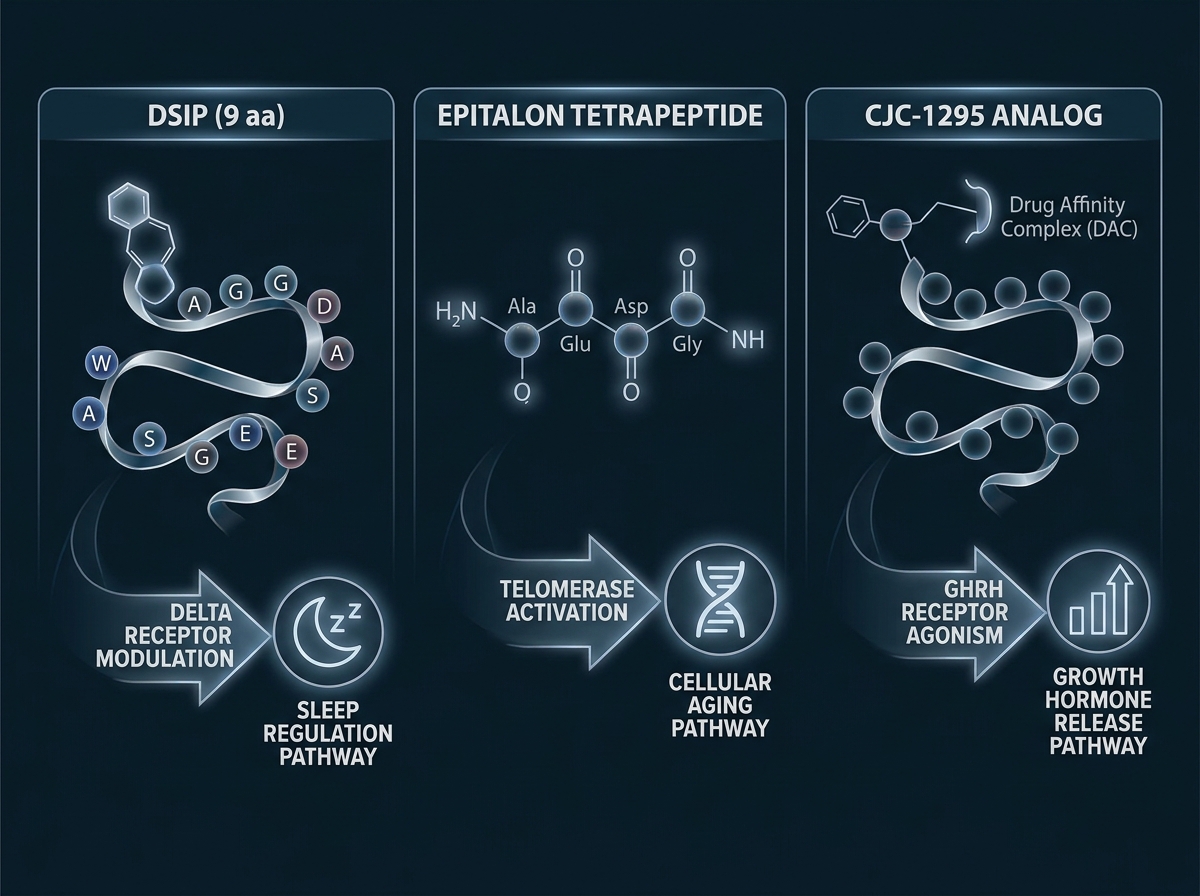
For men over 40, three peptides dominate the research-grade sleep conversation: DSIP (emideltide), epitalon, and CJC-1295. Of the three, DSIP has the most direct human sleep data, CJC-1295 has the strongest pharmacokinetic profile, and epitalon is the most speculative — but all three remain experimental and unapproved for any sleep indication.
Starting from
$49.99/mo
Free consultation

4.4 AHF · 4.2 Trustpilot
Four testosterone protocols, at-home labs and board-certified physicians, with no membership fee layered on top. The widest clinical range here for a man who does not yet know which route fits.
Get Started FreeDSIP vs. Epitalon: What the Evidence Actually Shows
DSIP's human trial record, while dated, is the most direct. Small double-blind studies from the 1980s and early 1990s — summarized across five protocols by Schneider-Helmert [8] — showed intravenous DSIP at 25 nmol/kg reduced sleep latency, improved sleep efficiency, and carried over improvements into the following night without the residual sedation typical of benzodiazepines. A 1987 seven-night intravenous trial in 14 chronic insomniacs [2] found sleep efficiency normalized to levels comparable to age-matched healthy controls. A 1992 parallel-groups study [1] found statistically significant but modest objective improvements, with the authors concluding short-term DSIP was "unlikely to provide major therapeutic benefit" for most chronic insomniacs. That's the honest summary: real signal, small trials, no modern replication.
Epitalon works through a different pathway — pineal gland support rather than direct sleep induction. Open-label data in adults aged 60–80 with documented low melatonin found subcutaneous epitalon (10 mg/day × 10 days) increased melatonin metabolite output by roughly 36% [5]. Participants reported better sleep continuity, but no polysomnography was performed. If your primary problem is circadian drift and blunted melatonin — common after 45 — epitalon has a plausible mechanism. If you want direct SWS augmentation, DSIP is the better-supported choice, despite its limitations.
Bottom line: DSIP > epitalon for direct deep-sleep evidence; epitalon > DSIP for circadian/melatonin-related complaints.
CJC-1295 and the GH-Sleep Axis
CJC-1295 is a GHRH analogue, and that distinction matters. Human studies show that intravenous GHRH administered during sleep consistently amplifies slow-wave sleep — in one paradigm, late-night GHRH produced nearly a tenfold increase in SWS without disrupting REM [16]. CJC-1295 operates through the same receptor pathway and produces sustained GH and IGF-1 elevations for 6–8 days per injection, making it a practical weekly-dosing candidate for telehealth protocols.
The critical caveat: no randomized trial has used polysomnography to confirm that CJC-1295 specifically improves SWS in middle-aged men [7]. The mechanistic logic is solid; the clinical proof is not. GHRP-based peptides (GHRP-2, ipamorelin alone) are weaker candidates — research shows GH elevation via the GHRP receptor pathway does not reliably enhance SWS the way GHRH-pathway stimulation does [16]. If you're running ipamorelin for GH pulse frequency, pairing it with a GHRH analogue like CJC-1295 is better supported for sleep architecture than ipamorelin alone. See our ipamorelin vs. sermorelin comparison for how these stack against each other on sleep and muscle goals.
For men exploring a structured protocol, NextGen Peptides offers third-party-tested CJC-1295 with documented purity certificates — relevant given the compounding quality variance in this market. A broader comparison of peptide therapy providers is available at /online-providers/peptide-therapy.
None of these peptides is FDA-approved for sleep. The FDA's compounding deliberations have classified both DSIP and CJC-1295 as unapproved research agents. Cognitive behavioral therapy for insomnia (CBT-I) remains first-line per AASM guidelines — peptides are adjuncts at best, not replacements. For a broader look at stacking peptides after 40, our peptide stack for a 42-year-old male covers how practitioners are sequencing these compounds in 2026. More context on advanced therapy options is also available at /treatments/advanced-therapies.
Frequently asked questions
Which peptide is best for deep sleep in men over 40?
DSIP (emideltide) has the strongest direct human evidence for improving slow-wave sleep, based on multiple small double-blind trials [2][3][4], though all used intravenous administration at doses not replicated in current subcutaneous community protocols. CJC-1295 is the better-supported option for men who also want GH axis benefits alongside sleep improvement, given its GHRH-pathway mechanism and practical dosing. Epitalon is most appropriate when the primary complaint is circadian disruption or blunted melatonin rather than outright SWS deficiency.
Is CJC-1295 safe for sleep use in middle-aged men?
CJC-1295 is generally well tolerated in research settings, with the main documented risks being injection-site reactions, transient water retention, and potential IGF-1 elevation over time. No serious adverse events specific to sleep use have been reported in the published literature [7]. Because it elevates GH and IGF-1 sustainably, men with a personal or family history of hormone-sensitive conditions should consult a physician before use
Why is ipamorelin alone considered weaker than CJC-1295 for improving deep sleep?
Ipamorelin alone is a weaker choice for sleep architecture because GH elevation via the GHRP receptor pathway does not reliably enhance slow-wave sleep the way GHRH-pathway stimulation does. CJC-1295 works as a GHRH analogue, and human studies show GHRH administered during sleep can produce nearly a tenfold increase in SWS without disrupting REM. Pairing ipamorelin with a GHRH analogue like CJC-1295 is therefore better supported for sleep outcomes than running ipamorelin on its own.
Nutrition & Metabolic Health Specialist · 8+ years specializing in men's nutrition, Extensive training in clinical nutrition and metabolism
Taylor is a nutrition specialist focusing on men's metabolic health and weight management. With deep expertise in therapeutic nutrition for hormone disorders, Taylor researches and explains how nutrition impacts testosterone, metabolism, and overall male wellness.
Tools and references for this topic
Free calculators and reference charts built from the same sources as this article.
- CalculatorPeptide mcg to mg Converter: Micrograms, Milligrams and Units
- CalculatorPeptide Blend Calculator — Two Peptides in One Vial
- CalculatorPeptide Reconstitution Calculator: mcg to Units on a U-100 Syringe
- ChartPeptide Storage & Beyond-Use Dates — What Each Label Says
- ChartPeptide Reconstitution Chart — mcg per Unit (Printable)
Looking for an online provider?
Find a qualified online provider — compare options vetted and reviewed by Alpha Health Finder.