BPC-157 vs TB-500: Which Research Peptide Fits Your Protocol in 2026?
BPC-157 carries the stronger and more internally consistent preclinical evidence base for musculoskeletal repair — more animal models, more tissue types, more mechanistic detail. TB-500 (the thymosin β4 fragment LKKTETQ) rides on human data that technically belongs to its parent molecule, full-length thymosin β4, not to the heptapeptide fragment researchers actually source. Neither has cleared a Phase III randomized controlled trial for musculoskeletal endpoints, and no head-to-head comparison exists. That said, researchers running injury-focused protocols have real reasons to choose one over the other — and this breakdown maps those reasons directly.
Starting from
$85.95
N/A consultation

4.2 AHF · 4.2 Trustpilot
Best-in-class third-party testing for research compounds at competitive pricing — the legitimacy floor in a market full of untested suppliers.
Get Started FreeWhat Separates BPC-157 and TB-500 at the Mechanistic Level
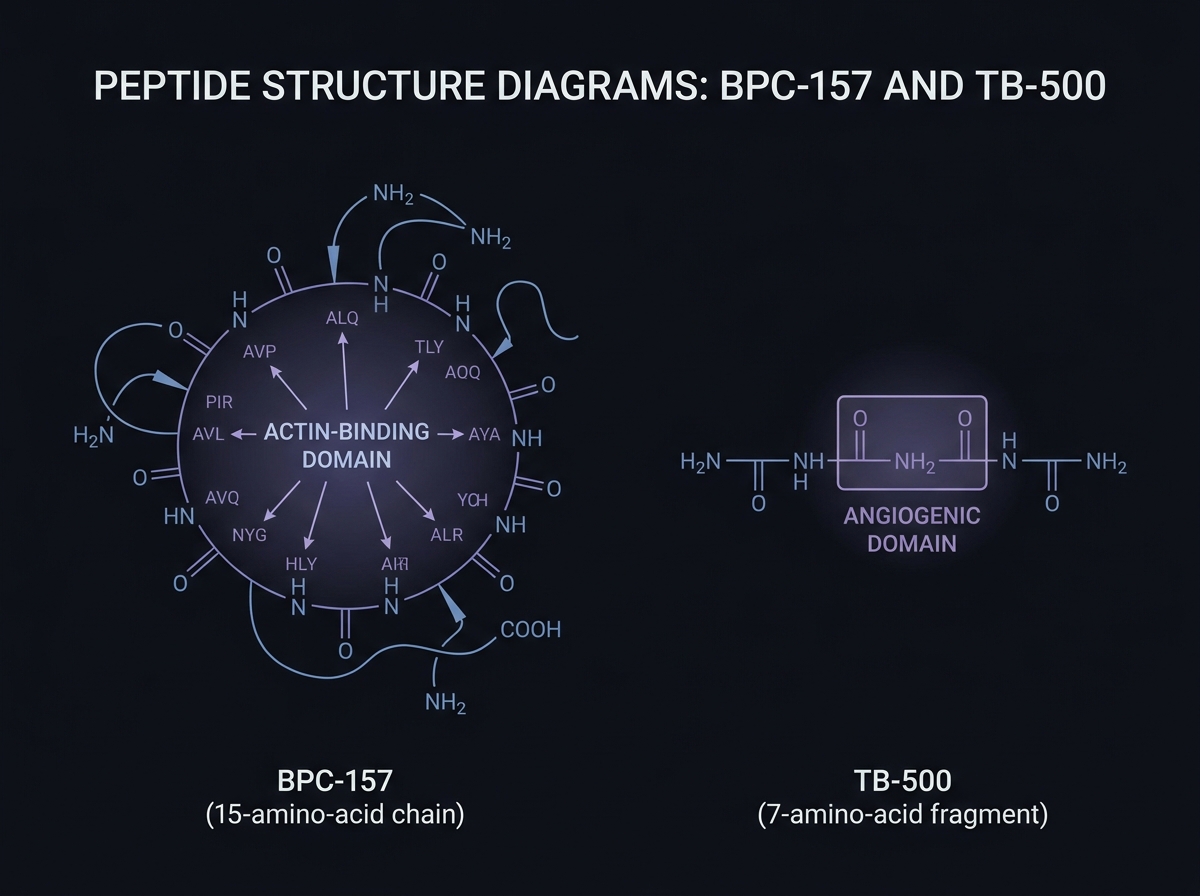
BPC-157 is a synthetic 15-amino-acid pentadecapeptide derived from a protective protein sequence isolated in human gastric juice [6]. It has been studied across a notably wide range of animal injury models — tendon, ligament, muscle, bone, gut mucosa, and peripheral nerve — with results that are internally consistent enough to suggest a genuine tissue-repair signal rather than noise [3][5][7]. Its proposed mechanisms include upregulation of growth hormone receptor expression, modulation of the nitric oxide pathway, promotion of angiogenesis via VEGF, and direct cytoprotective effects on endothelial cells [5][7]. The breadth of those mechanisms is part of what makes BPC-157 interesting to researchers studying recovery from orthopedic injuries.
TB-500 is a seven-amino-acid fragment (Ac-LKKTETQ) corresponding to amino acids 17–23 of thymosin β4, a 43-residue protein abundant in platelets and connective tissue [2]. That fragment contains the principal actin-binding motif that allows thymosin β4 to regulate cytoskeletal dynamics and cell migration. In practical terms, TB-500 is narrower in its documented mechanistic reach than the full protein — it handles actin sequestration and promotes cell motility, but the angiogenic and anti-apoptotic functions associated with full-length thymosin β4 may not be fully reproduced by the fragment [2][10].
For researchers comparing the two: BPC-157's mechanistic profile is better suited to acute tissue injury and gut-related research models. TB-500's profile, extrapolated from thymosin β4, points more toward chronic wound environments, epithelial repair, and post-ischemic tissue contexts. The overlap is real — both promote angiogenesis and reduce inflammatory burden — but the emphasis differs.
BPC-157: Preclinical Evidence and What It Actually Shows
The preclinical literature on BPC-157 is, by peptide-research standards, unusually large and reproducible [6][11]. Rat and mouse models of Achilles tendon transection, rotator cuff injury, and medial collateral ligament damage consistently show accelerated histological healing, improved collagen organization, and faster return of tensile strength in BPC-157-treated animals versus controls [3][7]. In muscle crush models, BPC-157 reduces inflammatory infiltrate and promotes satellite cell activity. In bone defect models, it accelerates callus formation. In gut models — which reflect its original derivation context — it demonstrably protects against NSAID-induced ulceration and promotes mucosal healing [5].
Three small pilot studies have evaluated BPC-157 in humans, none of them randomized or adequately powered [6][12]. They establish rough tolerability at subcutaneous doses in the 200–500 mcg range but cannot speak to efficacy. Researchers should treat those reports as preliminary safety signals, not efficacy evidence. What the animal data does support is a reasonable hypothesis: BPC-157 accelerates soft-tissue repair through vascular and inflammatory modulation, making it a logical compound for musculoskeletal injury research.
Researchers sourcing BPC-157 for preclinical or observational protocols can compare verified vendors at NextGen Peptides, which carries research-grade BPC-157 with third-party purity documentation. For a detailed breakdown of injection protocols documented in the current literature, see our companion piece on BPC-157 injection protocols, dosing frequency, and what the 2026 evidence shows.
TB-500: What the Human Data Actually Belongs To
The most important framing correction for any TB-500 research protocol: every meaningful human clinical dataset — Phase I safety trials, ophthalmic efficacy trials, venous ulcer studies — was conducted using full-length thymosin β4, not the TB-500 fragment [2][10][15]. A 2010 U.S. Phase I trial administered recombinant thymosin β4 intravenously at doses up to 1,260 mg in healthy volunteers with no dose-limiting toxicity. A 2021 Chinese Phase I study in 84 volunteers confirmed dose-linear pharmacokinetics and a clean acute safety profile at 0.05–25 mcg/kg IV. The ophthalmic program using RGN-259 (thymosin β4 0.1% solution) showed near-significant improvement in corneal healing for neurotrophic keratopathy at day 29 (p = 0.066), reaching significance at day 43 (p = 0.036) [19].
None of that clinical work used LKKTETQ. No published pharmacokinetic study, no randomized trial, and no peer-reviewed efficacy report has used the TB-500 fragment in humans [10][15]. Researchers extrapolating from thymosin β4 to TB-500 are making a fragment-to-parent inference that has not been formally validated. That doesn't make TB-500 research uninteresting — the actin-binding fragment likely retains core biological activity — but it sets a clear ceiling on what can be claimed from the existing literature.
For researchers running TB-500 loading and maintenance protocols, our detailed reference on TB-500 dosing timelines, loading phase, and maintenance covers what the animal-derived literature supports week-by-week. Secondary sourcing options include Marek Health for researchers preferring a clinician-adjacent platform.
Research Protocols: Dosing Ranges Documented in the Literature
Empiric dosing protocols for both peptides circulate widely in research contexts, but neither has been validated in a controlled human trial. What follows reflects animal-derived scaling and non-peer-reviewed observational reports, not approved clinical guidance.
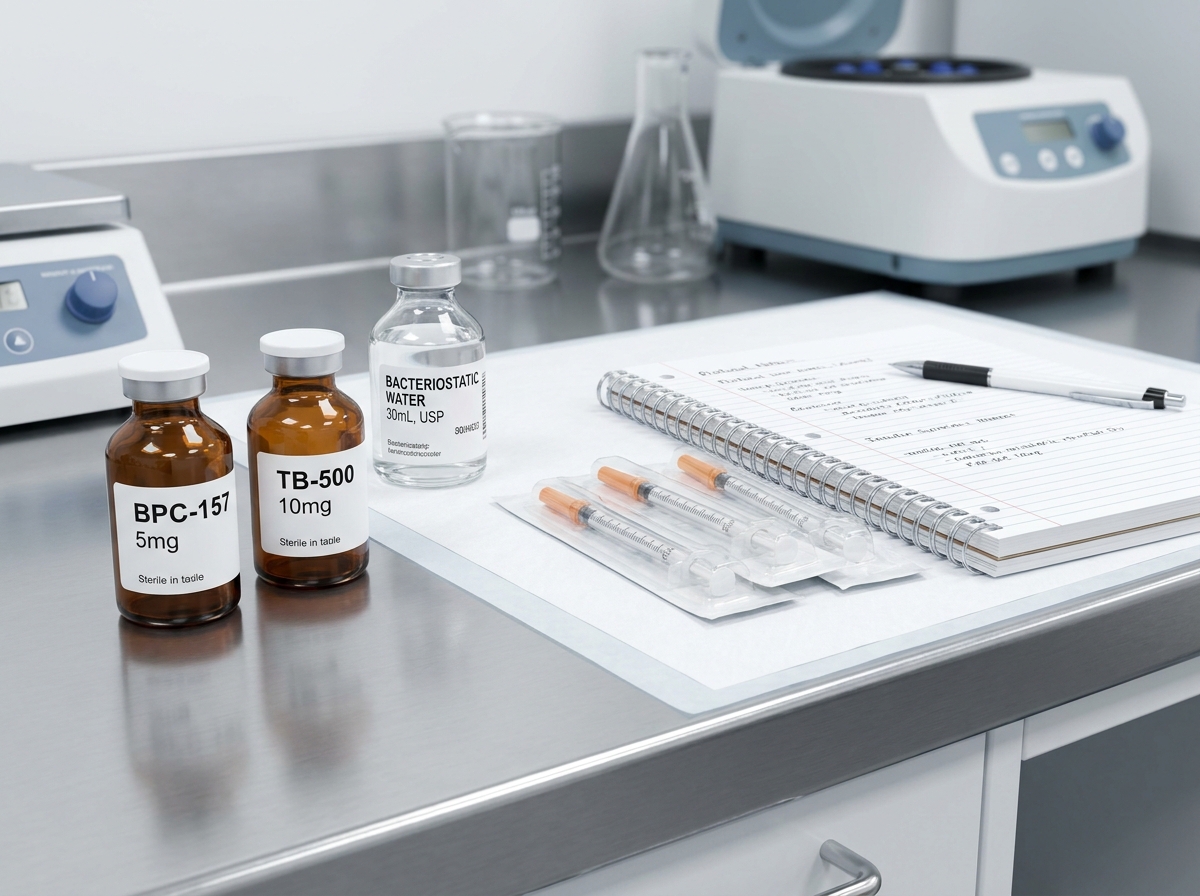
BPC-157 animal studies most commonly use systemic doses in the 10 mcg/kg range administered intraperitoneally or intramuscularly [3][5][7]. Human research protocols typically scale to 200–500 mcg per injection, subcutaneous or intramuscular, administered once or twice daily. Some protocols use localized injection near the target tissue; others use systemic subcutaneous injection in the abdomen. Duration in injury-focused animal studies ranges from 7 to 28 days, with functional improvements detectable by day 14 in most tendon models [3].
TB-500 empiric protocols in research settings typically involve 2–5 mg subcutaneous twice weekly during a 4–6 week loading phase, followed by 2–2.5 mg once weekly as maintenance [2][8]. These numbers are extrapolated from thymosin β4 dosing in animal models and are not pharmacokinetically validated for the fragment. Researchers using combination protocols pairing BPC-157 with TB-500 report observational synergy in connective tissue contexts — a plausible hypothesis given their non-overlapping primary mechanisms — but no controlled data exists to confirm it.
Researchers looking to compare current vendor pricing and formulation options can browse the peptide therapy treatment hub for a current supplier overview.
Sourcing Research-Grade BPC-157 and TB-500 in 2026
Both compounds occupy a defined regulatory position: they are research compounds legal to purchase for non-clinical research use, but neither is FDA-approved for human therapeutic application, and both were excluded from the FDA's 503A compounding bulk substances list. Researchers sourcing either peptide should verify third-party HPLC and mass spectrometry purity certificates, as adulteration and underdosing are documented problems in the unregulated peptide supply chain [1][6].
Vendor selection criteria that matter for research integrity: published certificate of analysis (CoA) for each lot, minimum 98% purity by HPLC, sterility testing documentation for injectable-grade preparations, and clear labeling as "for research use only." NextGen Peptides publishes lot-specific CoAs and is a primary reference vendor in this category. Pricing as of mid-2026 runs approximately $35–55 per 5 mg vial of BPC-157 and $40–70 per 5 mg vial of TB-500 at research-grade suppliers, with bulk discounts available for multi-vial orders.
For researchers comparing peptide options beyond these two compounds — including growth hormone secretagogues like ipamorelin — the ipamorelin dosing protocols for 2026 reference covers a complementary mechanistic space. Broader peptide sourcing comparisons are indexed at /online-providers/peptide-therapy.
BPC-157 vs TB-500: Which Protocol Fits Which Research Goal
The honest comparison: BPC-157 is the better-supported choice for acute soft-tissue injury models — tendon, ligament, muscle, and gut — based on the volume and consistency of preclinical evidence [6][7]. Researchers studying recovery from orthopedic insult, inflammatory bowel models, or peripheral nerve damage have a more coherent preclinical rationale for BPC-157 than for TB-500.
TB-500 makes more sense in research contexts focused on chronic wound healing, epithelial repair, or cardiac tissue — areas where full-length thymosin β4's human pilot data provides at least some translational signal, and where the actin-cytoskeletal mechanism is particularly relevant [2][10]. It is also the more studied compound in corneal and vascular contexts. Researchers who specifically want to study the thymosin β4 pathway should note that the human evidence base belongs to the full protein; TB-500 is a reasonable fragment proxy but not a validated substitute.
For researchers who want both mechanistic angles covered, combination protocols pairing BPC-157 (for acute repair signaling) with TB-500 (for cytoskeletal and angiogenic support) are documented in observational research contexts — see our comparative breakdown at BPC-157 vs TB-500: which peptide is better for recovery and injury healing. Neither peptide has been evaluated against GLP-1 class compounds like semaglutide (Wegovy) or tirzepatide (Mounjaro) in tissue-repair contexts, though the NEJM's STEP and SURMOUNT trial series established metabolic benchmarks that increasingly frame the broader peptide research landscape. The regenerative peptide field operates in a different mechanistic lane, but researchers working across metabolic and musculoskeletal domains are increasingly tracking both.
Frequently Asked Questions
What is the main difference between BPC-157 and TB-500?
BPC-157 is a 15-amino-acid peptide derived from a gastric protective protein, with a large and consistent animal-model evidence base across tendon, muscle, gut, and nerve tissue [6][7]. TB-500 is a 7-amino-acid fragment of thymosin β4, a naturally occurring actin-binding protein; its human clinical data technically belongs to the full-length parent molecule, not the fragment itself [2][10]. In practical research terms, BPC-157 has stronger preclinical support for acute soft-tissue repair, while TB-500 maps more closely to epithelial, vascular, and chronic wound research contexts.
How do researchers dose BPC-157 for musculoskeletal injury models?
The most commonly referenced research protocol for BPC-157 uses 200–500 mcg per injection, administered subcutaneously or intramuscularly once or twice daily, for 14–28 days [5][8]. These ranges are extrapolated from animal studies using approximately 10 mcg/kg systemically. No validated pharmacokinetic study has established optimal human dosing, so all protocols in current use remain empiric and should be treated as observational reference points rather than clinical guidance.
Is TB-500 the same as thymosin β4?
TB-500 is not the same as thymosin β4 — it is a seven-amino-acid fragment (LKKTETQ) of the 43-amino-acid full protein [2][10]. All peer-reviewed human clinical trials, including Phase I safety studies and ophthalmic efficacy trials, used full-length recombinant thymosin β4. TB-500 itself has no published human pharmacokinetic or efficacy data. Researchers should account for this distinction when interpreting the literature: claims about TB-500's "proven" human safety draw on data from a structurally different molecule.
Where can researchers source BPC-157 and TB-500 at verified purity?
Research-grade BPC-157 and TB-500 are available from peptide suppliers including NextGen Peptides, which publishes lot-specific certificates of analysis. Researchers should require a minimum 98% purity by HPLC and mass spectrometry confirmation before using any peptide in a controlled protocol.
Nutrition & Metabolic Health Specialist · 8+ years specializing in men's nutrition, Extensive training in clinical nutrition and metabolism
Taylor is a nutrition specialist focusing on men's metabolic health and weight management. With deep expertise in therapeutic nutrition for hormone disorders, Taylor researches and explains how nutrition impacts testosterone, metabolism, and overall male wellness.
Looking for an online provider?
Find a qualified online provider — compare options vetted and reviewed by Alpha Health Finder.