Low-level laser therapy (LLLT) is a legitimate adjunct with real randomized-trial data, but current research shows it adds little when layered onto minoxidil, and it has not been tested against minoxidil head-to-head in adequately powered trials.
That summary matters because the marketing around LLLT devices has outpaced the science. Before spending $500–$900 on a laser helmet, men with male pattern hair loss deserve a clear-eyed look at what the evidence actually says about each option, where they overlap, and when one beats the other on practical grounds.
Starting from
$59/mo
Free consultation

4.2 AHF · 3.9 Trustpilot
ODT delivery + L-Arginine/Oxytocin combo formulation is genuinely differentiated ED tech — faster absorption, novel combo profile, mid-tier pricing.
Get Started FreeHow Each Treatment Works — and Why the Mechanisms Matter
Minoxidil's hair-growth effects were discovered as an unintended side effect of an oral antihypertensive. Decades of subsequent research suggest it works by shortening the telogen (resting) phase, accelerating re-entry into anagen (active growth), prolonging anagen duration, and enlarging follicle size — all of which increase the proportion of follicles actively producing visible hair [3]. In vitro work has also shown minoxidil stimulates dermal papilla cell proliferation and upregulates vascular endothelial growth factor, which may support the perifollicular microvasculature [3]. Critically, minoxidil does not touch the hormonal pathway driving androgenetic alopecia, which is why it works in both men and women and stacks cleanly with anti-androgens like finasteride.
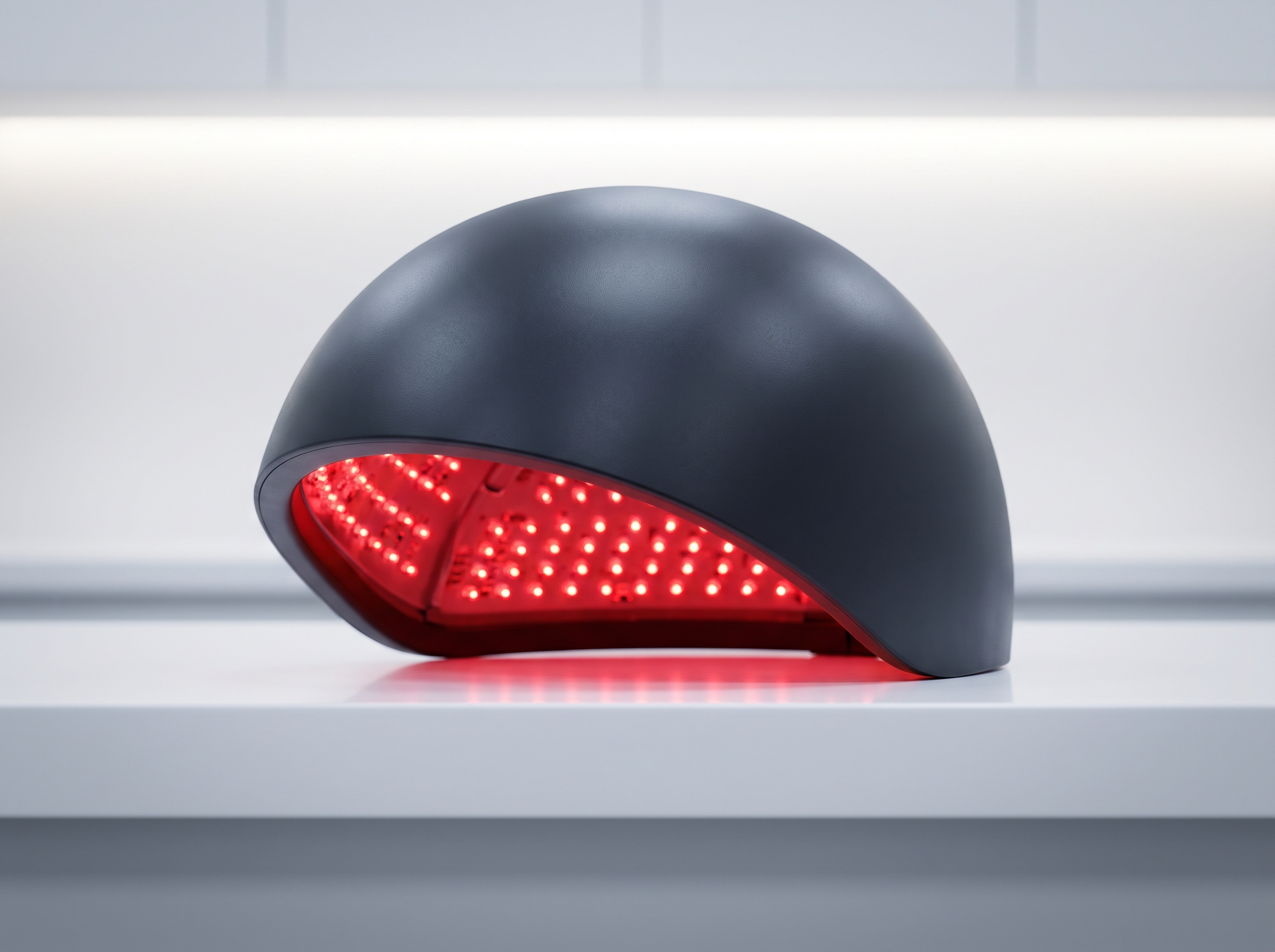
LLLT devices — combs, helmets, and caps — emit low-intensity red or near-infrared light, typically around 650–680 nm, at power densities too low to generate heat or cause tissue ablation. The proposed mechanism is photobiomodulation: light energy absorbed by cytochrome c oxidase in mitochondria increases ATP production, reduces oxidative stress, and upregulates growth factors that may shift follicles from telogen toward anagen [13]. The biological plausibility is reasonable, but the specific molecular pathway in human scalp follicles remains less characterized than minoxidil's pharmacology [13]. Device parameters — wavelength, irradiance, pulse frequency, and session duration — vary considerably across products, which contributes to the heterogeneity seen in clinical trials.
Both modalities target follicular cycling rather than androgen signaling. Neither is a cure. Stop either treatment, and the gains reverse as follicles revert to their baseline miniaturization trajectory [19]. That maintenance reality should shape expectations before any money changes hands.
What the Clinical Evidence Says About Minoxidil
The efficacy case for topical minoxidil is the strongest in non-surgical hair restoration. A meta-analysis of topical minoxidil trials found a mean increase in total hair count of approximately 16.68 hairs per cm² versus placebo, and about 20.90 hairs per cm² for non-vellus (terminal) hair [9]. Investigator assessments showed minoxidil more than doubled the probability of visible improvement (relative risk 2.28), and patient self-reports confirmed a 56% higher likelihood of perceived regrowth [9].
The S3 European Dermatology Forum guideline — the most comprehensive evidence-based consensus on AGA — rates topical minoxidil 2% twice daily at evidence level 1 for both male and female pattern hair loss, and 5% twice daily at evidence level 2 for men, with the higher concentration producing greater density gains at the cost of modestly more local irritation [20]. The American Academy of Dermatology lists minoxidil as its most recommended treatment for female pattern hair loss [19]. That level of guideline endorsement reflects not just efficacy data but also decades of post-marketing safety surveillance.
The standard topical protocol — 1 mL of solution or half a cap of 5% foam applied to dry scalp twice daily, left on for at least four hours — is well established [20]. Expect the first visible shedding surge around weeks two through eight (follicles cycling into anagen synchronously), stabilization by month three, and meaningful density improvements between months six and twelve with consistent use [16]. Maximal benefit typically appears near the one-year mark.
Men who want prescription-level oversight and custom formulations — including combination minoxidil-finasteride topical solutions — can access those through telehealth platforms. Strut Health offers compounded topical combinations with physician oversight, which is a reasonable starting point for men who want more than over-the-counter 5% foam. For a broader comparison of hair loss providers, the hair loss provider directory lists options across price points.
What the Clinical Evidence Says About LLLT
The pivotal device-level data for LLLT comes from a 26-week multicenter sham-controlled trial of the HairMax LaserComb in men with Norwood-Hamilton class IIa–V hair loss [11]. Among 110 completers randomized 2:1 to active device versus a sham unit using incandescent light, the laser group showed significantly greater terminal hair density gains (p < 0.0001) and better patient-reported regrowth scores (p < 0.015) [11]. No serious adverse events occurred, and adverse-effect rates were statistically equivalent between groups — an important safety signal [11]. This data package supported the FDA 510(k) clearance that allowed HairMax to market the device for AGA [15].
A separate Thai RCT evaluated a helmet-type device (RAMACAP) in 40 men and women with AGA over 24 weeks [7]. At week 24, the laser helmet group outperformed sham on hair density (p = 0.002), hair diameter (p = 0.009), and investigator global photographic assessment [7]. Side effects were limited to temporary shedding and mild scalp itch [7]. The trial's main limitation was its small sample and the absence of follow-up beyond six months, leaving durability of response an open question.
A 2024 systematic review and meta-analysis synthesizing 38 studies and 3,098 patients — 2,930 of them with AGA — found that LLLT produced a standardized mean difference in hair density of 1.14 (95% CI 0.51–1.78) for treatment durations under 20 weeks and 1.44 (95% CI 0.97–1.91) for durations exceeding 20 weeks versus placebo [13]. Those are moderate-to-large effect sizes on paper. The catch: heterogeneity was high (I² > 80%), meaning device parameters, treatment protocols, and patient populations varied enough across studies that pooled numbers should be interpreted cautiously [13]. Effect sizes from any one device may differ substantially from the pooled estimate.
Hims and Roman both offer LLLT devices alongside their minoxidil and finasteride subscriptions, if you want a single platform managing the full stack. The hair restoration treatment hub covers the broader landscape of options including PRP and topical anti-androgens.

Head-to-Head: Does Adding LLLT to Minoxidil Actually Help?
This is the question that matters most clinically — and the answer, based on current data, is probably not. A 54-patient RCT randomizing men to LLLT twice weekly plus 5% topical minoxidil versus minoxidil alone found a 14.78% improvement in hair density in the combination group versus 11.43% in the minoxidil-only group after 16 weeks [5]. The difference was not statistically significant (p = 0.45), and physician global assessments and patient satisfaction scores also showed no meaningful separation [5]. The authors concluded that adding LLLT to minoxidil did not produce significant additional benefit [5].
A 2025 systematic review and meta-analysis specifically designed to answer this question identified four eligible RCTs comparing minoxidil monotherapy against minoxidil plus LLLT [6]. The pooled mean difference in hair count was −0.04 (95% CI −1.22 to 1.14; p = 0.95; I² = 0%), and hair diameter showed no difference either (p = 0.98) [6]. Zero heterogeneity across trials on that outcome is actually a meaningful signal — it suggests consistent null results rather than averaged noise. The conclusion: combining minoxidil with LLLT does not significantly improve outcomes compared with minoxidil alone [6].
This does not mean LLLT is ineffective in isolation — the sham-controlled trials described above show it clearly outperforms placebo. It means that once minoxidil is working, adding a laser device on top appears to deliver marginal incremental gain for considerable incremental cost. For men who are tolerating and responding to minoxidil, the budget for a $700 laser cap is probably better spent on sustained minoxidil access or a consultation about adding finasteride.
Sesame Care offers affordable telehealth consultations for hair loss prescriptions, which is a cost-effective way to discuss whether a combination regimen makes clinical sense for your specific pattern and timeline.
Oral Minoxidil, Combination Pharmacotherapy, and Where LLLT Fits
The comparison between LLLT and minoxidil is complicated by the expanding evidence base for oral low-dose minoxidil, which offers systemic delivery without the twice-daily topical routine. A meta-analysis of four RCTs comparing oral versus topical minoxidil found no significant difference in hair density (SMD 0.02; p = 0.88) or hair diameter (SMD −0.25; p = 0.34) between routes [2]. Oral administration did produce significantly more hypertrichosis (risk ratio 2.01; p = 0.01), reflecting greater systemic exposure and generalized hair stimulation [2]. Oral minoxidil carries cardiovascular warnings including a boxed warning for pericardial effusion at antihypertensive doses — low-dose hair-loss regimens use far smaller amounts, but the label warrants baseline cardiovascular screening for any patient with relevant risk factors [17].
A JAMA Dermatology network meta-analysis ranking treatments by efficacy in male AGA placed 5 mg oral minoxidil among the top-tier regimens for terminal hair count at 24 weeks, above topical 5% and 2% minoxidil [1]. Dutasteride 0.5 mg/day ranked highest overall, followed by finasteride 5 mg, then oral minoxidil 5 mg [1]. LLLT was not included in that particular network because it lacks the standardized dosing and trial design needed for drug-class comparisons, which itself is revealing about the maturity gap between pharmacologic and device evidence.
When minoxidil is combined with finasteride, the results are consistently superior to either alone. A systematic review found combined topical finasteride-minoxidil solutions outperformed minoxidil monotherapy in hair density (mean difference 9.22 hairs/cm²) and hair diameter (mean difference 2.26 µm) [8]. A large retrospective series of oral low-dose minoxidil plus finasteride reported stable or improved outcomes in over 92% of men at 12 months [8]. LLLT offers no equivalent pharmacologic synergy with anti-androgens — it is a different modality operating through a different pathway, and its role in multi-agent regimens is less clearly defined.
Men looking to explore combination pharmacotherapy should consider providers with licensed prescribers who can supervise finasteride plus minoxidil protocols. PeterMD and MangoRx both operate in this space with physician-supervised hair loss programs. For a deep comparison of topical anti-androgen options, see our piece on topical dutasteride vs topical finasteride for hair restoration in 2026.
Cost, Practicality, and Who Should Choose What
The practical gap between minoxidil and LLLT is as significant as the efficacy gap. Generic topical minoxidil 5% solution costs roughly $10–$25 per month at most pharmacies, with foam formulations running $30–$45. Oral low-dose minoxidil, prescribed off-label, typically costs $15–$40 per month depending on pharmacy and dose. LLLT devices range from approximately $200 for basic laser combs to $500–$900 for helmet and cap systems with higher diode counts; some clinical-grade devices exceed $3,000. The upfront LLLT cost equals 18–36 months of minoxidil before any ongoing use is counted.
Both treatments require indefinite continuation. Stopping minoxidil leads to reversal of gains within three to six months [19]. LLLT's durability of effect after discontinuation is less well studied, but the AAD explicitly notes it is unclear whether these devices can continue producing new growth over the long term [19]. Long-term safety data for chronic LLLT exposure also remain limited, whereas minoxidil's safety profile over decades of use is well documented.
That cost-benefit calculus points toward a clear default: minoxidil first, LLLT selectively. Specific scenarios where LLLT makes most sense include patients who are intolerant of topical minoxidil (contact dermatitis, persistent scalp irritation), women who are pregnant or breastfeeding and should avoid minoxidil [19], patients who philosophically prefer non-pharmacologic management, or individuals who want to maintain coverage in a single scalp region where minoxidil application is difficult. For men already on adequately dosed minoxidil and responding to it, the evidence does not justify the device expense [5][6].
DudeMeds offers competitively priced minoxidil subscriptions with clinical oversight — a reasonable anchor for men building a foundational hair loss protocol. For a parallel look at how evidence-based cost-benefit reasoning applies to other men's health interventions, our review of PRP vs shockwave therapy for ED in 2026 uses the same framework.
The Bottom Line: Where to Start and How to Build a Protocol
Minoxidil is the foundational treatment for androgenetic alopecia in both men and women. The evidence for it is stronger, the cost is lower, the safety record is longer, and the guideline endorsement is unambiguous [19][20]. Start there. If tolerability is good and response is adequate, adding LLLT does not meaningfully improve outcomes — the meta-analytic data are consistent and clear on that point [6].
For men willing to add pharmacologic layers, combining minoxidil with finasteride (or topical dutasteride for those concerned about systemic anti-androgen exposure) produces significantly better outcomes than either agent alone [8]. That combination stack — not LLLT — is where the evidence points for men who need more than minoxidil monotherapy. Maximus provides physician-supervised protocols for men pursuing multi-agent hair restoration regimens.
LLLT earns a role as a second-line adjunct for patients who cannot use pharmacologic treatments, not as a premium upgrade for those who can. The S3 guideline recommends it as ancillary therapy rather than first-line, and explicitly withholds a recommendation for or against use beyond six months pending longer-term data [20]. That is an honest summary of where the science stands in 2026: LLLT is real, it is safe, it outperforms sham — but it is not the place to start, and it does not belong in the budget before minoxidil is optimized.
Frequently Asked Questions
Is LLLT better than minoxidil for hair growth?
No — minoxidil has stronger clinical evidence, guideline endorsement at evidence level 1, and a longer safety record than any currently available LLLT device. A meta-analysis of topical minoxidil trials found it increased total hair count by approximately 16.68 hairs per cm² versus placebo and more than doubled the probability of clinician-assessed improvement [9]. LLLT produces statistically significant improvements versus sham devices [11][13], but direct head-to-head trials comparing LLLT monotherapy against minoxidil monotherapy have not been conducted at adequate scale. Based on indirect evidence and the overall quality of each modality's evidence base, minoxidil is the more reliable option.
Can you use LLLT and minoxidil at the same time?
You can, but the evidence does not show meaningful benefit from combining them. A 54-patient RCT found that LLLT plus minoxidil improved hair density by 14.78% versus 11.43% for minoxidil alone — a difference that was not statistically significant (p = 0.45) [5]. A separate meta-analysis of four RCTs comparing minoxidil monotherapy to minoxidil plus LLLT found no significant differences in hair count or hair diameter between the two groups [6]. Men already tolerating and responding to minoxidil should focus additional resources on pharmacologic upgrades (adding finasteride or dutasteride) rather than LLLT devices.
What are the main side effects of minoxidil compared to LLLT?
Minoxidil's most common side effects include initial shedding in the first two to eight weeks, scalp irritation (dryness, itching, scaling), and unwanted facial or body hair from solution spread [16][19]. Oral minoxidil adds hypertrichosis at more than double the rate of topical use and carries cardiovascular warnings at higher doses, including a boxed warning for pericardial effusion [17]. LLLT's adverse-event profile in controlled trials has been minimal — temporary shedding and mild scalp itch are the most reported effects, with no serious adverse events in published trials [7][11]. However, long-term LLLT safety data are limited, and the AAD acknowledges uncertainty about chronic device use [19].
How long does it take to see results from minoxidil or LLLT?
Minoxidil typically shows stabilized shedding by month two to three and visible density improvement between months six and twelve with consistent twice-daily application; the FDA label notes some men may not see results for at least four months [16]. LLLT trials have generally run 16–26 weeks and show significant improvements relative to sham by week 24 in most positive studies [7][11]. Both timelines are similar, and both require indefinite continuation — stopping either treatment leads to gradual loss of gains as follicles revert to their untreated state [19]. Neither option produces results within weeks; realistic expectations center on a six-to-twelve-month evaluation window.
Is LLLT a good option for women with hair loss?
LLLT has been tested in women with androgenetic alopecia and shows statistically significant improvements in hair density and diameter versus sham [7]. The AAD acknowledges that LLLT devices are FDA-cleared and that some studies show efficacy for female pattern hair loss [19]. For women who are pregnant or breastfeeding — groups who should avoid minoxidil due to fetal risk and potential breast milk transfer [19] — LLLT represents a reasonable non-pharmacologic alternative during that period. Outside of that specific scenario, topical minoxidil 2–5% remains the better-evidenced first-line option for women with AGA [20].
Where can I get a minoxidil prescription with physician oversight?
Several telehealth platforms prescribe minoxidil — both topical and low-dose oral — with licensed physician supervision. Strut Health specializes in compounded hair loss formulations including combination minoxidil-finasteride topical solutions. Sesame Care offers lower-cost telehealth consultations for those who want a prescription without a full subscription model. The hair loss provider directory compares platforms across pricing, formulations, and prescription scope.
Sources
[1] JAMA Dermatology — Network Meta-Analysis of AGA Treatments
[2] International Journal of Dermatology — Oral vs Topical Minoxidil Meta-Analysis
[3] British Journal of Dermatology — Minoxidil Mechanisms
[5] PMC — LLLT Plus Minoxidil vs Minoxidil RCT
[6] PubMed — Systematic Review: Minoxidil vs Minoxidil + LLLT
[7] Lasers in Medical Science — RAMACAP Helmet RCT
[8] Journal of Cosmetic Dermatology — Combination Therapy Advances in AGA
[9] PubMed — Topical Minoxidil Meta-Analysis
[11] PubMed — HairMax LaserComb RCT
[13] PubMed — Systematic Review and Meta-Analysis of LLLT in Alopecia
[15] FDA 510(k) Clearance — HairMax LaserComb
[16] DailyMed — Minoxidil Topical Solution 5% Label
[17] Medscape — Minoxidil (Loniten) Monograph
[19] American Academy of Dermatology — Female Pattern Hair Loss
[20] S3 European Dermatology Forum — Androgenetic Alopecia Guideline
Alpha Health Finder Editorial Team
Editorial Team
The Alpha Health Finder editorial team researches and writes evidence-based men's health content. Articles are grounded in cited primary sources and reviewed against a fixed editorial standard before publication. We are a research and directory team — not your prescribing clinicians.
Looking for an online provider?
Find a qualified online provider — compare options vetted and reviewed by Alpha Health Finder.
One email a week. The research, not the hype.
What we published this week, what we changed our minds about, and what it means if you are on a protocol.
No spam, no selling your address. Unsubscribe in one click.