PP405 vs Minoxidil for Androgenetic Alopecia: What the 2026 Evidence Shows
PP405, a first-in-class topical mitochondrial pyruvate carrier inhibitor, produces faster visible regrowth than minoxidil in early trials — but minoxidil has decades of controlled-trial data behind it, and PP405 is not yet commercially available. If you're choosing a treatment today, minoxidil remains the evidence-backed standard; PP405 is the most compelling investigational challenger to watch.
Starting from
$4/dose
Free consultation

4.1 AHF · 4.2 Trustpilot
Lowest-priced sildenafil in telehealth — async-light intake fits straightforward ED, not cases that need workup.
Get Started FreeHow They Work — and Why the Difference Matters
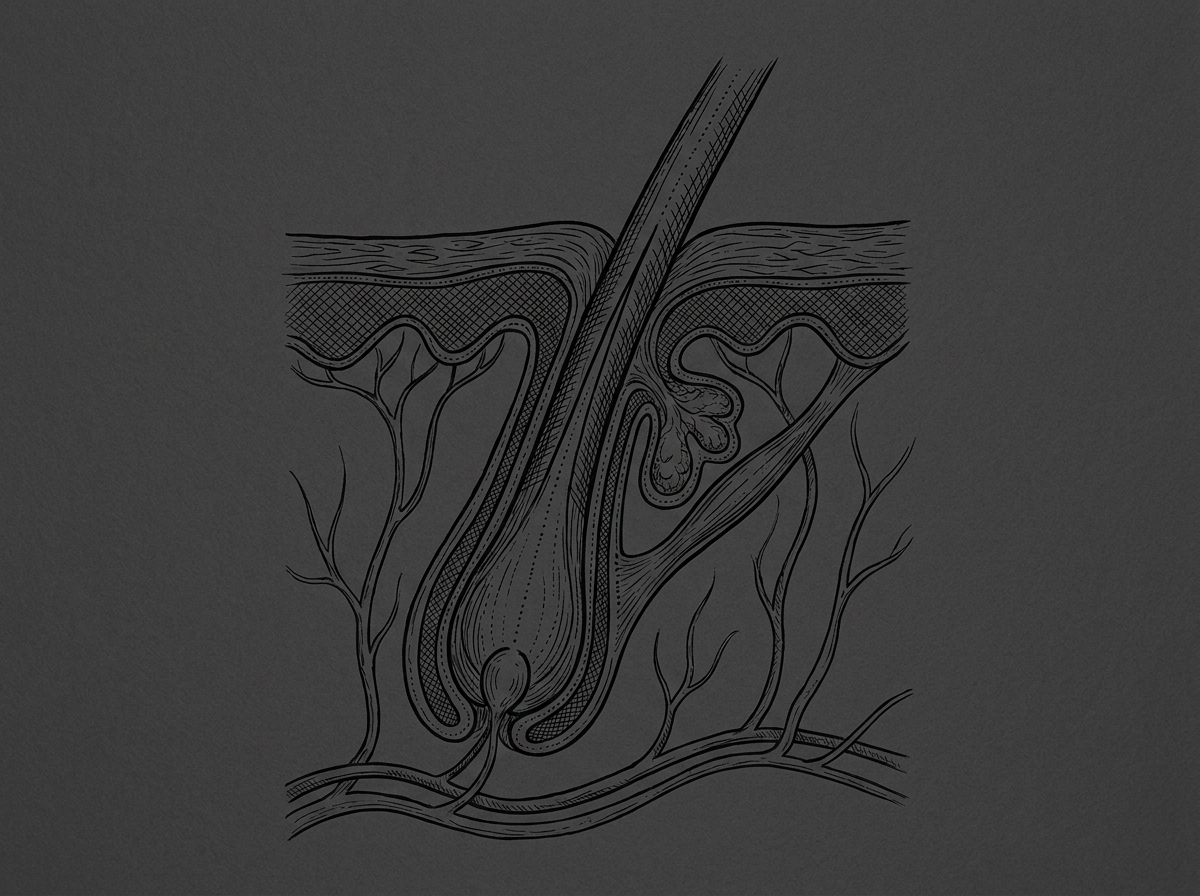
Minoxidil is a prodrug converted by scalp sulfotransferases into its active sulfate form, which opens ATP-sensitive potassium channels, dilates perifollicular blood vessels, and upregulates growth factors like VEGF and IGF-1 [7]. It prolongs anagen and reduces telogen duration. It does not touch androgen signaling, which is why it works in both men and women — but it also can't reverse the underlying DHT-driven miniaturization driving androgenetic alopecia (AGA).
PP405 takes a fundamentally different approach. It inhibits the mitochondrial pyruvate carrier complex (MPC1/MPC2), forcing hair follicle stem cells (HFSCs) to shift from oxidative phosphorylation toward glycolysis [2]. That metabolic state appears to lift HFSCs out of quiescence and push them into anagen — including in follicles that have been dormant for years [4]. The mechanism is entirely androgen-independent, which means it should theoretically work regardless of a patient's DHT status or whether they're on finasteride. For a deeper look at how antiandrogens stack against each other, see our comparison of pyrilutamide vs finasteride for hair loss.
What the Clinical Numbers Actually Say
Topical 5% minoxidil delivers mean nonvellus hair-count increases of roughly 20–22 hairs/cm² at 16 weeks versus vehicle, with a relative risk of investigator-rated improvement of 2.28 (95% CI 1.58–3.31) over placebo [7]. Those are solid, reproducible numbers from multiple RCTs spanning decades. Oral low-dose minoxidil (LDOM) adds breadth: a 2026 meta-analysis of 27 studies covering 2,933 patients found 47% showed improvement and 35% achieved significant improvement — though most of that data is observational, not randomized [8]. If you're weighing topical against oral routes, our breakdown of oral vs topical minoxidil for men covers the tradeoffs in detail.
PP405's Phase 2a trial (NCT06393452, n=78) ran the active gel for just 28 days [3]. At week 8 — four weeks after treatment stopped — 31% of men with advanced AGA (Norwood III–V) hit a greater than 20% increase in hair density versus 0% in the placebo arm [1][5]. No systemic absorption was detected at any point, a meaningful safety advantage over oral minoxidil's cardiovascular risk profile [1][3]. The catch: 78 subjects, 28-day dosing window, no head-to-head comparator arm, and no long-term durability data yet. You can find hair-loss providers currently offering minoxidil and emerging options at Shed, one of the better-reviewed telehealth platforms in this category.
For a broader view of the current hair restoration treatment landscape, including surgical and non-drug options, the AHF treatment hub is a useful reference. Those evaluating all their topical options should also check the deoxyribose gel vs minoxidil comparison for another investigational agent entering this space.
Frequently asked questions
Is PP405 available to buy in 2026?
PP405 is not commercially available as of September 2026. It remains in clinical development following Phase 2a results; Phase 2b and Phase 3 trials have not yet been completed. Patients interested in access should monitor ClinicalTrials.gov (NCT06393452) for expanded trial enrollment or compassionate-use updates [3].
Does PP405 work better than minoxidil for advanced hair loss?
Early Phase 2a data suggest PP405 produces faster density gains in advanced AGA than minoxidil typically achieves at equivalent timepoints — 31% of men with Norwood III–V loss hit a greater than 20% density increase at eight weeks [1][5]. However, no direct head-to-head trial exists, and minoxidil's long-term maintenance data over five-plus years far exceeds anything PP405 has yet demonstrated. Calling PP405 superior is premature; calling it promising is accurate.
Can you combine PP405 with minoxidil or finasteride?
No combination trials have been published as of September 2026. Because PP405 acts via HFSC metabolic reactivation and minoxidil acts via follicular microenvironment support, their mechanisms are additive in theory [4][6]. Similarly, pairing PP405 with a DHT blocker like finasteride or dutasteride could address both upstream androgen drive and downstream stem-cell dormancy simultaneously — but that remains speculative until trial data arrive. Discuss combination strategies with a dermatologist through a platform like Peter MD, which offers physician-supervised hair-loss protocols.
Alpha Health Finder Editorial Team
Editorial Team
The Alpha Health Finder editorial team researches and writes evidence-based men's health content. Articles are grounded in cited primary sources and reviewed against a fixed editorial standard before publication. We are a research and directory team — not your prescribing clinicians.