How Testosterone Therapy Existed Before Testosterone Was Discovered: The Forgotten 1930s Story
Men were being "treated" with testicular extracts decades before anyone knew testosterone existed. The 1930s pivot from quackery to genuine hormone science — driven by Ernest Laqueur's isolation of testosterone from bull testes in 1935 and Leopold Ruzicka's Nobel-winning synthesis — is the real origin story of every injectable, gel, and pellet prescribed today.
Starting from
$99/mo
Free consultation

3.9 AHF · 4.2 Trustpilot
Lowest-priced enclomiphene TRT-alternative at scale — fits a narrow case, not full testosterone replacement.
Get Started FreeFrom Brown-Séquard's Syringe to Actual Science
In 1889, the eminent neurologist Charles-Édouard Brown-Séquard injected himself with a slurry of dog and guinea pig testis extract and declared he'd reversed thirty years of aging. His report in The Lancet ignited a continent-wide organotherapy craze. The problem: Australian researchers later determined each injection contained roughly 186 ng of testosterone per day — against the 6 mg a normal male produces daily. The "rejuvenation" was pure placebo [3][4].
Serge Voronoff took the next logical (if grotesque) step: grafting baboon testicular tissue into aging men. Scientific committees eventually labeled his results "poppycock." The grafts necrotized; there was no sustained androgen output. Yet thousands of procedures were performed across Europe and North America before the evidence caught up [7].
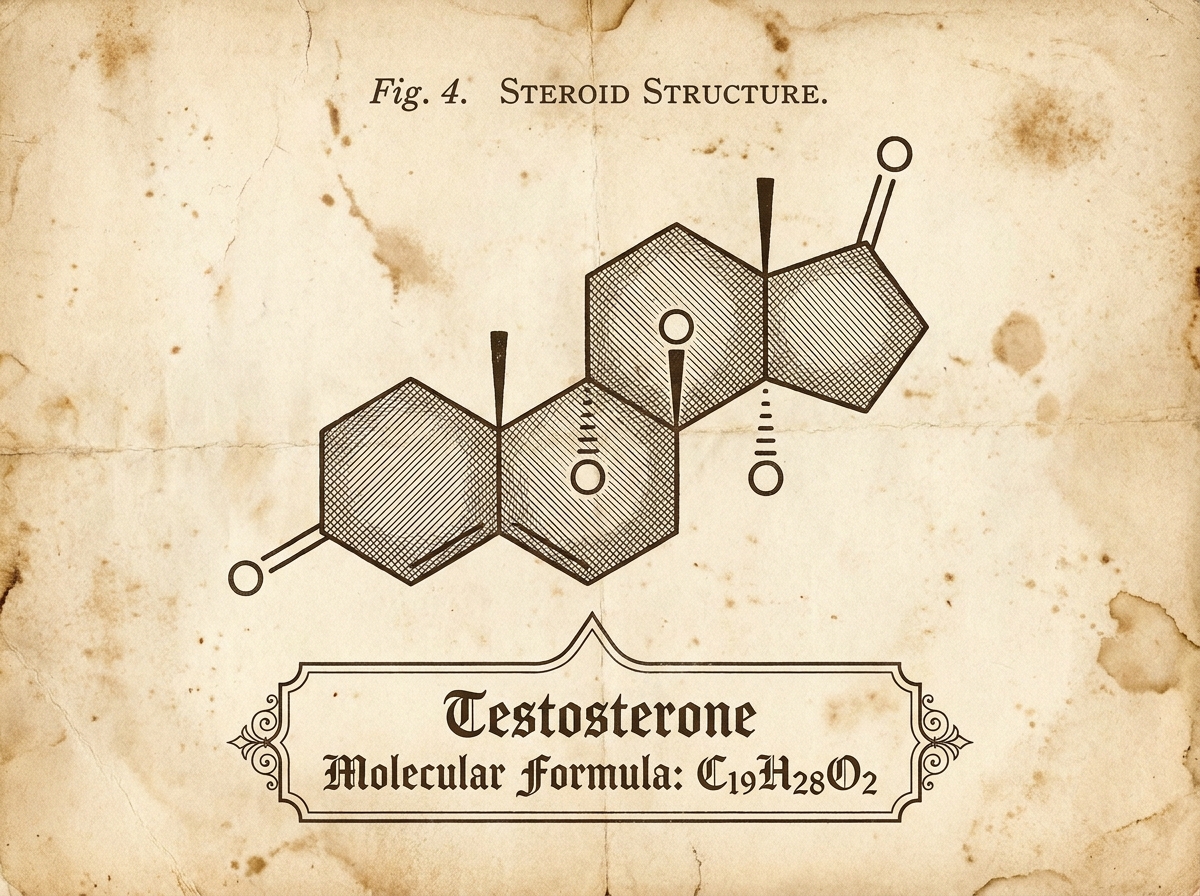
What Brown-Séquard and Voronoff lacked was the molecule itself. When Laqueur's team at Organon extracted 10 mg of 17β-hydroxy-4-androstene-3-one from 100 kg of bull testes in 1935 — and Ruzicka simultaneously published its chemical synthesis — organotherapy was finished. For the first time, you could dose a man with a defined compound and measure what happened [7][8].
If you're curious how gut health intersects with endocrine function in a similarly underappreciated way, see how your gut microbiome may be lowering your testosterone.
What the 1930s Discoveries Actually Built
Testosterone propionate, the first esterified injectable, received U.S. regulatory approval in 1937. Carl Moore at the University of Chicago demonstrated that IM injections restored secondary sexual characteristics in castrated men — proof of concept that exogenous androgen could substitute for absent testicular production [2][7]. That single demonstration underlies every TRT protocol written since, including today's formulations like Depo-Testosterone (testosterone cypionate) and Xyosted (subcutaneous testosterone enanthate).
The Endocrine Society Clinical Practice Guidelines on male hypogonadism now recommend 75–100 mg weekly or 150–200 mg every two weeks for IM esters — dosing precision that would have been unimaginable to Brown-Séquard. Topical options like AndroGel and Testim weren't possible until the molecular structure was defined. Neither was Natesto, the nasal gel that avoids transdermal transfer concerns entirely. The 1930s didn't just produce testosterone therapy; they made the pharmacological specificity of modern hormone optimization possible.
The Testosterone Trials (TTrials), the NIH-funded 7-arm study reported by Bhasin et al. 2018 in NEJM, quantified benefits that 1940s clinicians had only described anecdotally — improved sexual function, corrected anemia, increased bone density [1]. The data confirmed what the organotherapy era could never prove: defined dosing of a known molecule produces measurable, reproducible outcomes.
For a deeper look at how estrogen balance factors into modern TRT — something the 1930s researchers didn't anticipate at all — read estradiol is not your enemy on TRT.
If you want to discuss these historical context points with a clinician who orders actual bloodwork before prescribing, Marek Health is among the more transparent TRT providers operating in 2026 — compare the full field at /online-providers/hrt.
Frequently asked questions
Did testosterone therapy actually work before testosterone was discovered?
No — pre-1935 organotherapy produced no clinically meaningful androgen effect. Radioimmunoassay analysis of Brown-Séquard's injections showed roughly 186 ng of testosterone per day, against a physiological requirement of ~6 mg. The benefits men reported were placebo responses, not pharmacological ones [3][4].
When was the first real testosterone medication approved?
Testosterone propionate was the first FDA-approved androgen therapy, cleared in 1937 — two years after Laqueur isolated testosterone and Ruzicka synthesized it [2][7]. It required injections every one to three days due to its short half-life; longer-acting esters like testosterone cypionate and enanthate followed in the 1950s.
How does this history affect which TRT option a patient should consider today?
The 1930s lesson is that delivery method determines pharmacological outcome. Oral ingestion of testicular material failed because of first-pass metabolism — the same reason unmodified testosterone taken orally is ineffective. Modern choices (IM esters like Depo-Testosterone, topical gels like AndroGel, long-acting injectables like Aveed, or SERMs like Clomid for men preserving fertility) each solve the delivery problem differently, per Endocrine Society guidelines. Matching the formulation to the patient's lifestyle and lab profile matters more than historical preference.
Nutrition & Metabolic Health Specialist · 8+ years specializing in men's nutrition, Extensive training in clinical nutrition and metabolism
Taylor is a nutrition specialist focusing on men's metabolic health and weight management. With deep expertise in therapeutic nutrition for hormone disorders, Taylor researches and explains how nutrition impacts testosterone, metabolism, and overall male wellness.
Tools and references for this topic
Free calculators and reference charts built from the same sources as this article.
- CalculatorTRT Cost Calculator — Cost Per Month, With and Without Insurance
- ComparisonTRT vs hCG — Two Approved Drugs, One Shared Indication
- CostsTRT Cost Without Insurance: What the Drug Actually Costs
- CalculatorTestosterone Dose Calculator — Weekly mg to mL and Syringe Units
- CalculatorTestosterone Levels by Age — Reference Range Chart (Travison 2017)
Looking for an online provider?
Find a qualified online provider — compare options vetted and reviewed by Alpha Health Finder.