
Night Owls vs. Early Risers: What Research on 26,000 People Found About Cognitive Function
A UK Biobank study of 26,820 adults found that self-described evening types scored modestly higher on standardized cognitive tests than definite morning types — even after adjusting for age, sleep duration, health conditions, and lifestyle factors.[1] The finding doesn't mean staying up late makes you smarter, but it does mean the cultural assumption that early risers have a cognitive edge is not well supported by the data.
What the 26,000-Person Study Actually Showed
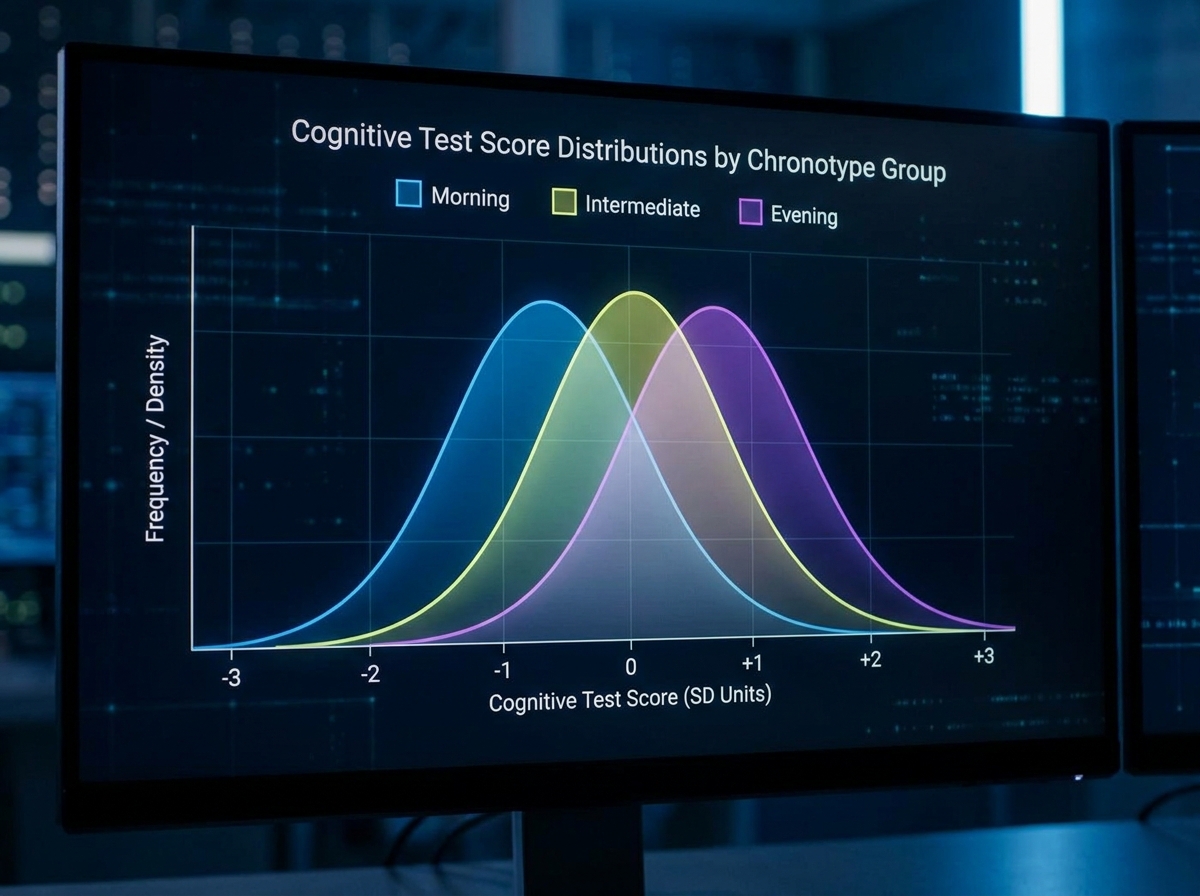
Researchers analyzed two cohorts — 10,067 participants completing four cognitive tasks (reasoning, memory, reaction time, prospective memory) and 16,753 completing two — and compared performance across chronotype groups.[1][2] Evening types scored roughly 0.135 standard deviations above morning types in Cohort 1, and 0.075 standard deviations above in Cohort 2.[1] Intermediate types also outperformed morning larks in both samples. These are small effect sizes by behavioral science standards, but they replicated cleanly across independent samples, which matters.
Sleep duration told a parallel story. Men sleeping 7–9 hours outperformed both short sleepers and long sleepers on composite cognitive scores.[9] Extended sleep beyond nine hours was actually associated with the steepest cognitive penalties — likely because it often signals underlying illness, sleep apnea, or fragmented nighttime sleep rather than genuine rest. If you're logging 10-hour nights and still feel foggy, that's worth investigating through a provider that handles hormone optimization and sleep-related health.
The cohort skewed older (ages 53–86), so these findings speak most directly to middle-aged and older men. Younger men — who trend naturally toward later chronotypes — may show different patterns, and the study didn't stratify results by sex, so male-specific effect sizes remain an open question.[1][9]
Sleep Duration Matters More Than Wake-Up Time
The chronotype finding gets the headlines, but the sleep-duration data carries more practical weight for most men. Experimental research on chronic partial sleep restriction found that men showed significantly worse psychomotor speed and processing performance than women after just two nights of restricted sleep, and slower reaction times after five nights.[8] Those gaps closed during recovery — the damage is reversible — but it accumulates faster in men than the comparable data suggests for women.
For the full breakdown of what sleep debt does physiologically, see what sleep deprivation does to the male body. The short version: reaction time, executive function, and cognitive flexibility take the first hits, in that order. Men who run on six hours and feel "fine" are largely experiencing adaptation to impairment, not genuine resilience.
The fertility angle is underappreciated. Men sleeping fewer than six hours per night showed approximately 12% lower sperm volume compared with those sleeping 8.0–8.5 hours, and poor sleep quality (PSQI >5) was associated with 4–8% reductions in total and progressive sperm motility.[20] Being a night owl isn't the problem — chronically short sleep is. A man with an evening chronotype who banks a consistent eight hours is in a materially different position than one who goes to bed at 2 a.m. and wakes at 6.
If you're managing sleep issues alongside broader men's health concerns, DudeMeds offers telehealth access to providers who can evaluate sleep quality in the context of hormonal and metabolic health — relevant given the established links between cortisol dysregulation, testosterone, and sleep architecture.
The Practical Takeaway for Men
Evening chronotype is partly genetic and partly environmental.[6][7] Forcing yourself into a 5 a.m. schedule against your biology doesn't guarantee cognitive gains — it may produce social jet lag and the sleep restriction penalties described above. The UK Biobank data supports working with your chronotype rather than against it, with one firm constraint: total sleep time needs to stay in the 7–9 hour range regardless of when that window falls.[2][9]
For men interested in evidence-based cognitive support beyond sleep timing, the comparison of Ritalin vs. Adderall for cognitive enhancement covers the pharmacological side of that conversation with similar rigor. Sleep optimization and pharmaceutical cognitive tools serve different use cases and shouldn't be conflated.
The bottom line: night owls don't need to reform. They need adequate, consistent sleep — and so does everyone else.
Frequently asked questions
Do night owls actually have better cognitive function than early risers?
In the UK Biobank study of 26,820 adults, evening types scored modestly higher on composite cognitive tests than definite morning types, with differences of approximately 0.075–0.135 standard deviations after adjusting for age, sleep duration, and health factors.[1][2] This is a real, replicated finding — but a small one, and it doesn't imply that shifting to a late schedule will improve your cognition. Chronotype partly reflects underlying neurobiology, not just habit.
How much sleep do men need to protect cognitive function?
Seven to nine hours per night is the range associated with the best cognitive scores in the UK Biobank data, and experimental research confirms that restricting sleep below this threshold produces measurable impairments in reaction time and executive function — with men showing deficits faster than women in controlled conditions.[8][9] Both short sleep (under six hours) and extended sleep (over nine hours) are associated with lower cognitive performance, so the goal is consistency within that window, not maximizing hours.
Can poor sleep affect male fertility as well as cognition?
Yes — men sleeping fewer than six hours per night show roughly 12% lower sperm volume compared with men sleeping 8.0–8.5 hours, and poor sleep quality is associated with 4–8% reductions in sperm motility.[20] These effects appear tied to sleep duration and quality rather than chronotype specifically
Nutrition & Metabolic Health Specialist · 8+ years specializing in men's nutrition, Extensive training in clinical nutrition and metabolism
Taylor is a nutrition specialist focusing on men's metabolic health and weight management. With deep expertise in therapeutic nutrition for hormone disorders, Taylor researches and explains how nutrition impacts testosterone, metabolism, and overall male wellness.