
Ritalin vs Adderall for Cognitive Enhancement: Which Is Cleaner and Less Addictive?
Methylphenidate (Ritalin) is the more defensible choice if you're weighing these two stimulants for cognitive enhancement — it produces small but measurable gains in recall and sustained attention, with a pharmacological profile that's somewhat less reinforcing than amphetamine. Neither drug is safe to use recreationally, both are Schedule II controlled substances, and the honest answer is that neither belongs in a healthy man's supplement stack.
How They Work — and Why the Mechanism Matters
Ritalin blocks dopamine and norepinephrine reuptake transporters, prolonging the action of catecholamines already released in prefrontal and striatal circuits [1][3]. It doesn't meaningfully force new dopamine out of storage vesicles. That restraint matters: smaller, slower dopamine surges in reward pathways mean less intense euphoria and, in theory, a lower ceiling on reinforcement.
Adderall (mixed amphetamine salts) does everything Ritalin does — plus it reverses transporter function to push dopamine out of terminals, disrupts vesicular storage via VMAT2, and inhibits monoamine oxidase [8]. The result is a larger, faster catecholamine spike. That's why Adderall feels "stronger" to most users, and it's exactly why the FDA's prescribing information for Adderall XR carries a prominent boxed warning about misuse, addiction, overdose, and death — language that's more emphatic than what appears on Ritalin's label [8][1].
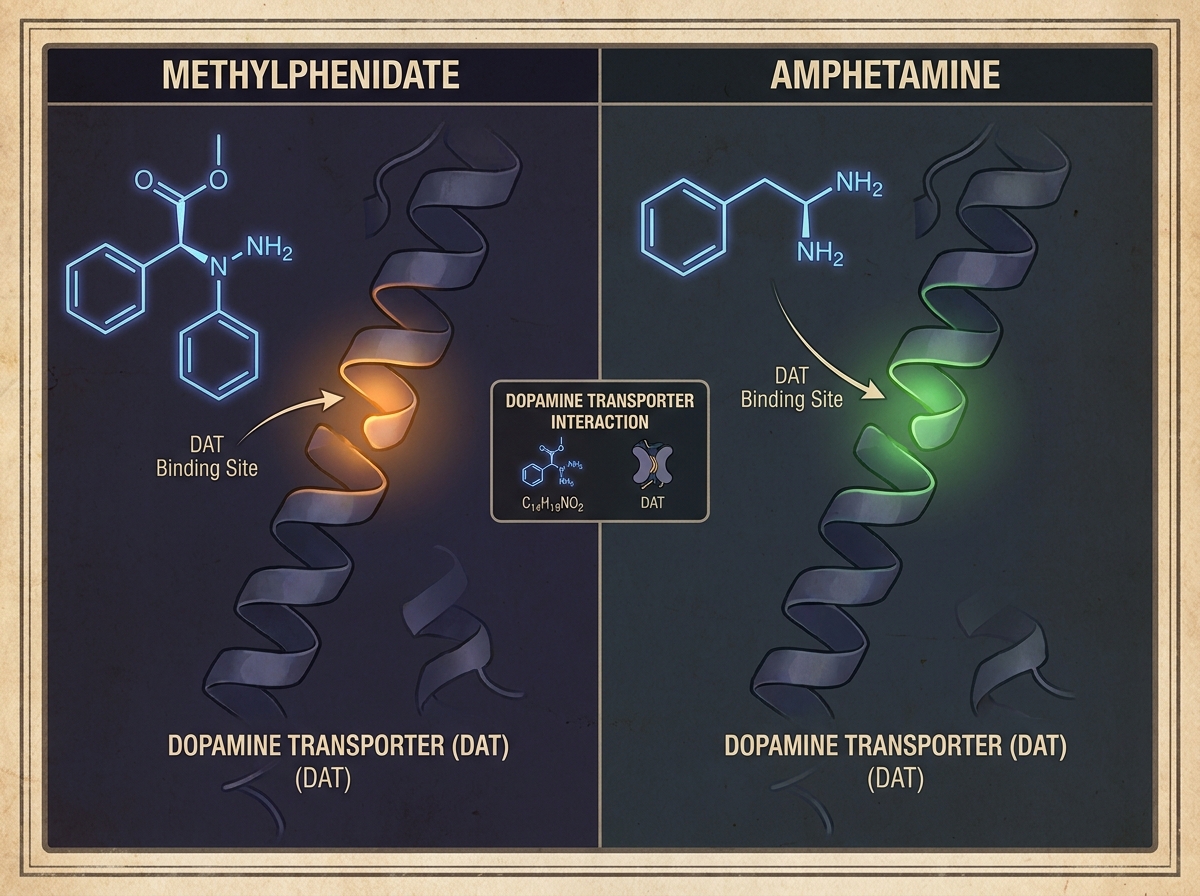
For men specifically, this dopaminergic difference intersects with higher baseline rates of substance use disorders and a neurobiological tendency toward risk-escalation in high-pressure environments [7]. The drug that feels more rewarding is the one more likely to become a problem.
What the Evidence Actually Shows on Cognition
A meta-analytic series comparing methylphenidate, modafinil, and d-amphetamine in healthy, non-sleep-deprived adults found that methylphenidate produced a small but statistically significant overall improvement (SMD = 0.21, 95% CI 0.09–0.32), driven by gains in recall, sustained attention, and inhibitory control [6]. D-amphetamine showed no significant overall cognitive benefit (SMD = 0.21, 95% CI −0.06 to 0.47) with high heterogeneity [6].
That's the key number most "smart drug" advocates skip: Adderall doesn't reliably outperform placebo on broad cognitive metrics in healthy adults [4][6]. Ritalin edges it out — but "edges it out" means modest, task-specific improvements, not a general intelligence boost. Processing speed accuracy and working memory see the most consistent signal; planning, decision quality, and creativity don't move reliably [2].
If you're exploring evidence-based cognitive and hormonal optimization together, the hormone optimization treatment hub covers the full landscape of approaches that carry stronger risk-benefit ratios than off-label stimulant use. You can also compare telehealth providers who handle ADHD diagnostics and related men's health at DudeMeds, which offers legitimate prescribing pathways if a clinical diagnosis is appropriate.
For a broader look at what actually moves the needle on daily energy and output, see our data-driven survey of what improves energy and productivity in men — most of the highest-ranked interventions don't require a DEA-scheduled prescription.
The Addiction and Safety Picture for Men
Both drugs are habit-forming. Human laboratory data confirm that oral methylphenidate at 16–48 mg produces dose-dependent "high" ratings and reinforcing behavior in stimulant-experienced volunteers [7]. The cleaner mechanism doesn't equal a clean safety record. Cardiovascular activation, sleep disruption, anxiety, and appetite suppression are common to both agents, and long-term high-dose amphetamine use carries neurotoxicity risk extrapolated from methamphetamine research [7][8].
For men on TRT or managing cardiovascular risk factors — a substantial overlap with the demographic asking this question — adding a stimulant that raises heart rate and blood pressure warrants serious caution. Our guide on what actually reduces cardiovascular risk in men over 40 is worth reading before stacking anything catecholaminergic.
If you have legitimate ADHD symptoms and want a proper evaluation rather than self-medication, Peter MD offers online ADHD assessment with prescribing authority in most states.
Frequently asked questions
Is Ritalin less addictive than Adderall?
Ritalin carries meaningfully lower addiction risk than Adderall based on pharmacological mechanism and regulatory classification, though both are Schedule II controlled substances with real abuse potential [1][8]. Methylphenidate's reuptake-only mechanism generates smaller dopamine surges in reward circuits than amphetamine's combined reuptake-blocking, release-forcing, and MAO-inhibiting action — which is why Adderall's FDA label includes a boxed warning about addiction and death that Ritalin's does not [8][1]. "Less addictive" is not the same as "safe to use recreationally."
Does either drug actually make healthy men smarter?
Neither drug produces broad, reliable cognitive enhancement in healthy, non-sleep-deprived men — the evidence for that claim is weak for both [6][4]. Methylphenidate shows small improvements in recall and sustained attention (SMD ~0.21–0.43 in meta-analyses), while d-amphetamine shows no statistically significant overall cognitive benefit in healthy adults [6]. Any perceived enhancement often reflects increased wakefulness and motivated
Which specific cognitive tasks show the most consistent improvement with Ritalin in healthy adults?
Ritalin most reliably improves recall, sustained attention, and inhibitory control in healthy non-sleep-deprived adults, while leaving planning, decision quality, and creativity largely unchanged. The meta-analytic data cited in the article found an overall effect size of SMD = 0.21 for methylphenidate, with processing speed accuracy and working memory showing the strongest signal. Broad cognitive metrics like general intelligence do not move reliably, meaning the benefit is task-specific rather than a general enhancement.
Nutrition & Metabolic Health Specialist · 8+ years specializing in men's nutrition, Extensive training in clinical nutrition and metabolism
Taylor is a nutrition specialist focusing on men's metabolic health and weight management. With deep expertise in therapeutic nutrition for hormone disorders, Taylor researches and explains how nutrition impacts testosterone, metabolism, and overall male wellness.