
How Artificial Sweeteners May Be Aging Your Brain by More Than a Year
Daily diet soda drinkers may be accelerating their cognitive decline at a rate equivalent to 1.3–1.6 extra years of brain aging, according to an eight-year prospective study of nearly 13,000 adults published in Neurology [1][6]. The effect is strongest in men under 60 — precisely the demographic most likely to reach for a zero-calorie drink to manage weight or blood sugar.
What the Research Actually Shows
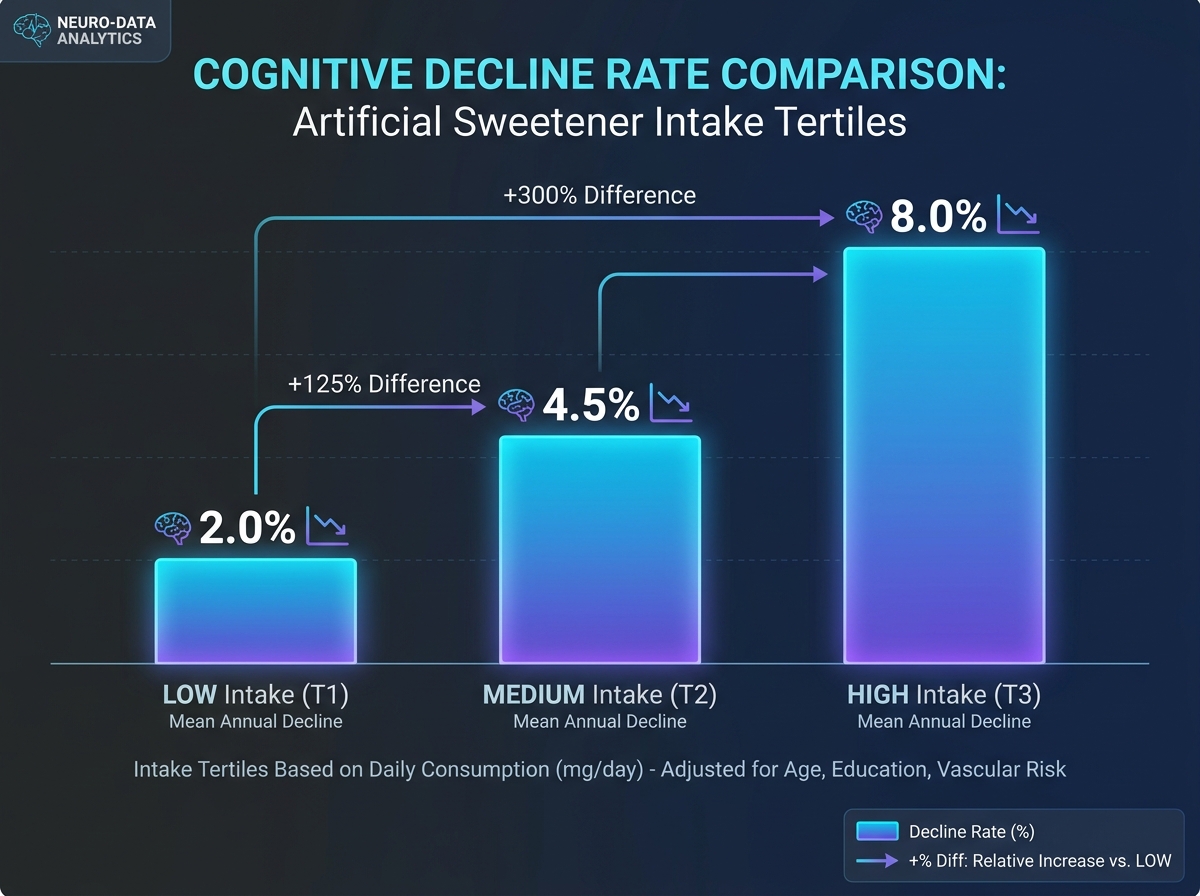
The ELSA-Brasil cohort study followed 12,772 middle-aged adults over eight years, measuring intake of seven specific low- and no-calorie sweeteners (LNCSs) and tracking memory, verbal fluency, and global cognition at multiple time points [6][11]. After adjusting for age, diabetes, hypertension, smoking, and overall diet quality, researchers found that participants in the highest sweetener intake tertile — averaging roughly 191 mg/day, about one diet soda's worth — experienced 62% faster global cognitive decline than the lowest-intake group [1][2]. The middle tertile, averaging 66 mg/day, declined 35% faster [3].
Verbal fluency took the hardest hit: highest-intake participants declined at 173% the rate of lowest-intake participants [8]. That's not a rounding error — it's the kind of word-retrieval slowdown men notice first at work or in conversation, often dismissing it as stress.
Six of the seven sweeteners studied — aspartame, saccharin, acesulfame-K, erythritol, xylitol, and sorbitol — were associated with faster decline. Tagatose was the sole outlier, showing no harmful association and a possible protective signal in adults under 60 [1][3].
Why Men Under 60 Face Disproportionate Risk
The age stratification in this study is the finding most men should sit with. Associations between LNCS consumption and cognitive decline were significant only in participants younger than 60 — not in the older cohort [4][6]. That means the men most likely to be loading up on diet beverages during their peak earning and performance years are also the ones absorbing the most cognitive risk.
Men in their 40s and 50s already carry higher rates of metabolic syndrome, hypertension, and vascular brain injury than women the same age. Add habitual sweetener use — which may disrupt insulin signaling, alter gut microbiome composition, and promote low-grade neuroinflammation — and you get a plausible multi-hit model for accelerated brain aging [8][9]. Diabetic men showed an even sharper association, particularly for memory decline, suggesting that impaired glucose metabolism amplifies whatever mechanism is operating [6].
This is also the demographic that typically isn't getting routine cognitive screening. Subtle declines in processing speed or word retrieval get chalked up to being busy, not to a daily habit that's been building for years.
If you're already working with a clinician on metabolic optimization, hormone optimization strategies that address insulin sensitivity and vascular health may reduce baseline cognitive risk independent of sweetener exposure.
The Causality Caveat — and Why It Doesn't Let You Off the Hook
The lead author, Dr. Claudia Kimie Suemoto, was explicit: this is correlation, not proven causation [2][3]. Observational data can't rule out reverse causation (people switching to diet products after early health changes) or residual confounding from ultra-processed food patterns that tend to cluster with sweetener use [6].
That caveat matters. But so does the magnitude. A 62% faster cognitive decline rate, replicated directionally by earlier Framingham Heart Study data linking daily diet soda consumption to nearly tripled ischemic stroke risk [5], is not a signal to wait for a randomized controlled trial before acting. The data are observational — but they're large, prospective, and adjusted. The prudent read is: reduce exposure, especially if you're under 60 with metabolic risk factors.
Practical reduction follows a simple audit: check labels on protein bars, energy drinks, "sugar-free" gum, and yogurt. Men often find their sweetener exposure extends well beyond the obvious diet soda. Substituting sparkling water, reducing overall sweetness exposure gradually, and improving carbohydrate quality are lower-risk paths to the same metabolic goals. Providers like DudeMeds can help structure metabolic health protocols that don't depend on artificial sweetener substitution as a primary tool.
For broader context on what dietary and lifestyle factors actually move the needle on men's cognitive health, see our breakdown of highest-return biohacks for men in 2026. And if environmental cognitive load is on your radar, the case for addressing indoor air quality and CO₂ exposure is similarly underappreciated.
Frequently asked questions
How much brain aging do artificial sweeteners actually cause?
The ELSA-Brasil Neurology study found that men and women in the highest sweetener intake group — roughly one diet soda's worth daily — experienced cognitive decline equivalent to approximately 1.6 additional years of brain aging over eight years, compared to low-intake peers [1][2]. The middle-intake group showed 1.3 extra years of decline. These are population-level associations from observational data, not guaranteed individual outcomes, but the effect size is large enough to take seriously.
Which artificial sweeteners are most linked to cognitive decline?
Six of seven sweeteners studied showed associations with faster cognitive decline: aspartame, saccharin, acesulfame-K, erythritol, xylitol, and sorbitol [1][3]. Tagatose was the only sweetener not linked to decline and showed a possible protective signal in adults under 60. The findings suggest meaningful differences between individual compounds, not a uniform class effect — though all six implicated sweeteners are extremely common in diet beverages and processed foods.
Nutrition & Metabolic Health Specialist · 8+ years specializing in men's nutrition, Extensive training in clinical nutrition and metabolism
Taylor is a nutrition specialist focusing on men's metabolic health and weight management. With deep expertise in therapeutic nutrition for hormone disorders, Taylor researches and explains how nutrition impacts testosterone, metabolism, and overall male wellness.