Your Office Air Is Making You Dumber: The Indoor CO₂ Problem in 2026
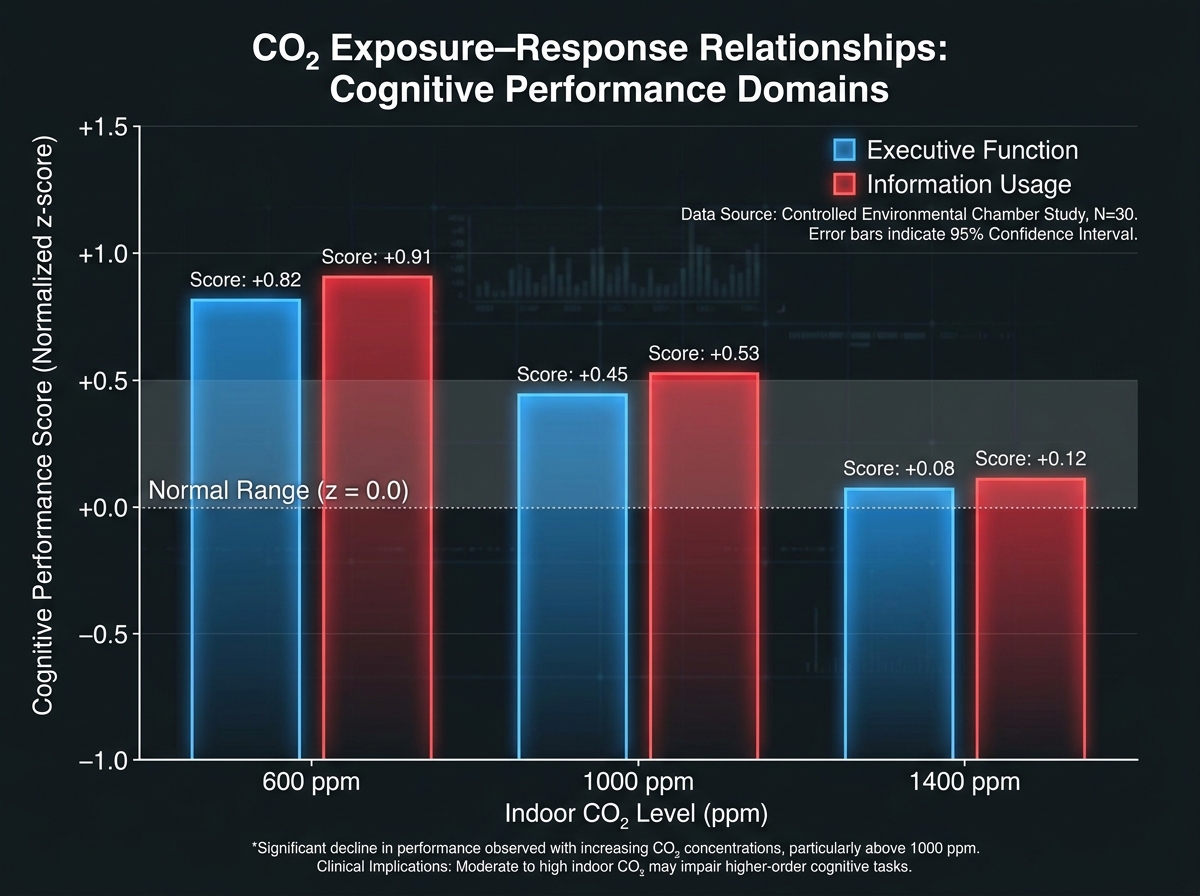
Elevated carbon dioxide in homes and offices is quietly degrading your ability to think — and the concentrations that cause measurable harm are far below any occupational safety limit. Controlled studies show cognitive scores drop 15–50% when indoor CO₂ climbs from roughly 600 ppm to 1,000–1,400 ppm, a range common in sealed conference rooms, home offices, and bedrooms worldwide [1][5].
What the Research Actually Shows
The landmark evidence comes from Harvard's controlled office experiments, where 24 workers were tested across blinded environmental conditions. At ~945 ppm CO₂, cognitive scores fell 15% versus a well-ventilated baseline; at ~1,400 ppm, they fell 50%. The hardest-hit domains were crisis response, strategic thinking, and information usage — precisely the higher-order functions men rely on in high-stakes work [1]. Earlier chamber work at Lawrence Berkeley National Laboratory replicated this: at 1,000 ppm of pure injected CO₂, six of nine decision-making scales declined significantly versus 600 ppm [5].
Field data reinforces it. The Global CogFx study tracked 302 office workers across six countries and found that every 500-ppm increase in CO₂ slowed response times 1.4–1.8% and cut cognitive throughput 2.1–2.4% — with no apparent lower threshold [4]. Those aren't dramatic numbers per transaction, but they compound across thousands of cognitive operations in a workday.
The bedroom problem is underappreciated. A field intervention study found that reducing bedroom CO₂ from ~2,400 ppm to ~835 ppm improved sleep efficiency, cut waking time, reduced morning cortisol, and improved next-day logical reasoning scores [12][13]. If you're sleeping in a sealed room, you may be starting every day already behind.
Why Men Are Disproportionately Exposed
Men are overrepresented in occupations — engineering, finance, technology, military operations — where long hours in enclosed, high-occupancy spaces are standard. Meeting rooms regularly hit 1,900 ppm during occupied hours [1][4]. Add the remote-work shift: home offices in spare rooms or basements with closed doors accumulate CO₂ steadily through a workday.
The vulnerability compounds with comorbidities. Men carry higher rates of obstructive sleep apnea, obesity, and cardiometabolic disease — all of which impair gas exchange and reduce cognitive reserve [6][7]. Snow et al. found that sleep-deprived participants became significantly sleepier under 2,700-ppm CO₂ even without measurable cardiovascular changes, suggesting a direct CNS pathway that hits harder when baseline resilience is already compromised [6].
If you're already managing factors that affect cognitive function — hormonal optimization, sleep quality, metabolic health — it's worth exploring hormone optimization resources alongside environmental interventions. The ceiling on your cognitive performance is set by multiple variables simultaneously, and CO₂ is one most men never audit.
For a broader look at high-return, evidence-grounded interventions, the highest-return biohacks for men in 2026 piece covers where CO₂ control fits relative to sleep, supplementation, and metabolic work.
What to Actually Do About It
The good news: these deficits reverse quickly — often within hours of improved ventilation [1][4]. Practical interventions rank roughly as follows:
Open windows when feasible. One bedroom study dropped CO₂ from 2,585 ppm to 660 ppm simply by opening a window — free, immediate, and effective [12].
Use a CO₂ monitor. Consumer devices (Aranet4, Airthings) run $100–$250 and give you real numbers. You cannot manage what you don't measure. Target below 800 ppm in work and sleep spaces.
Mechanical ventilation for sealed spaces. Energy Recovery Ventilators (ERVs) or Heat Recovery Ventilators (HRVs) exchange indoor and outdoor air without major heat loss. Installed costs run roughly $1,200–$8,000 depending on system size and complexity.
Behavioral fixes. Open your home office door. Take breaks outside. Run a box fan drawing outdoor air during deep work blocks. These are free and move the needle.
If cognitive performance is a serious priority and you're already optimizing sleep, training, and metabolic health, connecting with a men's health provider through DudeMeds can help you identify whether overlapping factors — testosterone, thyroid, sleep apnea — are amplifying your CO₂ sensitivity. Also see what actually stops men from getting sick all the time for how immune resilience and environmental load interact.
Frequently asked questions
What indoor CO₂ level actually impairs cognitive performance?
Cognitive impairment begins appearing at approximately 1,000 ppm in controlled studies, with a 15% drop in complex decision-making scores versus a well-ventilated baseline near 600 ppm [1][5]. At 1,400 ppm — routinely measured in occupied conference rooms — the decline reaches 50% on higher-order tasks. Most occupational guidelines still set limits at 5,000 ppm, which reflects acute toxicity thresholds, not cognitive performance thresholds.
How do I know if my indoor CO₂ is too high?
You need a dedicated CO₂ monitor — symptoms like mild brain fog and fatigue are nonspecific and easy to attribute to other causes. Consumer-grade monitors such as the Aranet4 or Airthings Wave Plus ($100–$250) provide accurate real-time readings. Target below 800 ppm in your primary work and sleep spaces;
Nutrition & Metabolic Health Specialist · 8+ years specializing in men's nutrition, Extensive training in clinical nutrition and metabolism
Taylor is a nutrition specialist focusing on men's metabolic health and weight management. With deep expertise in therapeutic nutrition for hormone disorders, Taylor researches and explains how nutrition impacts testosterone, metabolism, and overall male wellness.